
Walk a Coronado Street by Address
The most reliable street directory method moves from a modern address to a parcel, then from a parcel to named records. Start with the exact street form, including a direction or unit when one appears. Coronado’s numbered streets, lettered avenues, Orange Avenue spine, named curves, Silver Strand, and planned waterfront communities do not all behave like one mainland grid. Record the Coronado search date and preserve an old intersection or “between” description when a historical volume uses one.
- Run the address or street name through the secured assessment roll and record the APN, situs, and value fields.
- Open the county property-records page and select the matching parcel on the map, then note adjacent APNs.
- Ask Assessor Public Information for the owner and mailing address by phone or use a public kiosk.
- Search the owner as a grantee in the Official Records Index, then validate the legal description and APN at a kiosk when needed.
- Use city permits, historical directories, census schedules, or property files to add dated people and building clues.
This workflow makes the Coronado street directory an evidence chain for Coronado records. It distinguishes an owner, a recorded party, a permit applicant, and a published occupant rather than merging them into one household claim.
Search the Coronado Street Assessment Roll
The San Diego County Assessor’s secured roll supports Coronado parcel number, address, and street-name searches. Address mode is useful for a known house. Street Name mode helps walk a Coronado street when a number is missing or when a parcel has an unusual address. A full APN follows the format 123-456-78-90, with a minimum of eight digits. The web result shows APN, situs, land and improvement values, total assessed value, exemption amount, lien date, and year.
| Assessment field | Format or result | Street-directory use |
|---|---|---|
| Parcel Number | 123-456-78-90 | Stable Coronado key for a parcel and its map. |
| Address | Coronado street number and name | Find a Coronado situs when the APN is unknown. |
| Street Name | Coronado text search | Approximate street-by-street browsing. |
| Assessed values | Land, improvement, total, exemption | Describes the Coronado tax record, not the household. |
| Owner information | Coronado phone or kiosk channel | Online owner names are withheld; obtain them through the proper channel. |
The distinction between web and counter access is central to a Coronado street search. The county says ownership and address information are available by phone at 619-236-3771 and at public kiosks. A screen print costs $1, a parcel map $2, and a characteristic sheet $1. These are property-record channels, not a public list of non-owner occupants or other household members.
See the Coronado assessment search interface before running a street query. The county’s Coronado property records page explains the map and kiosk path.
The captured Coronado property screen from the county is available through the official property-records link.
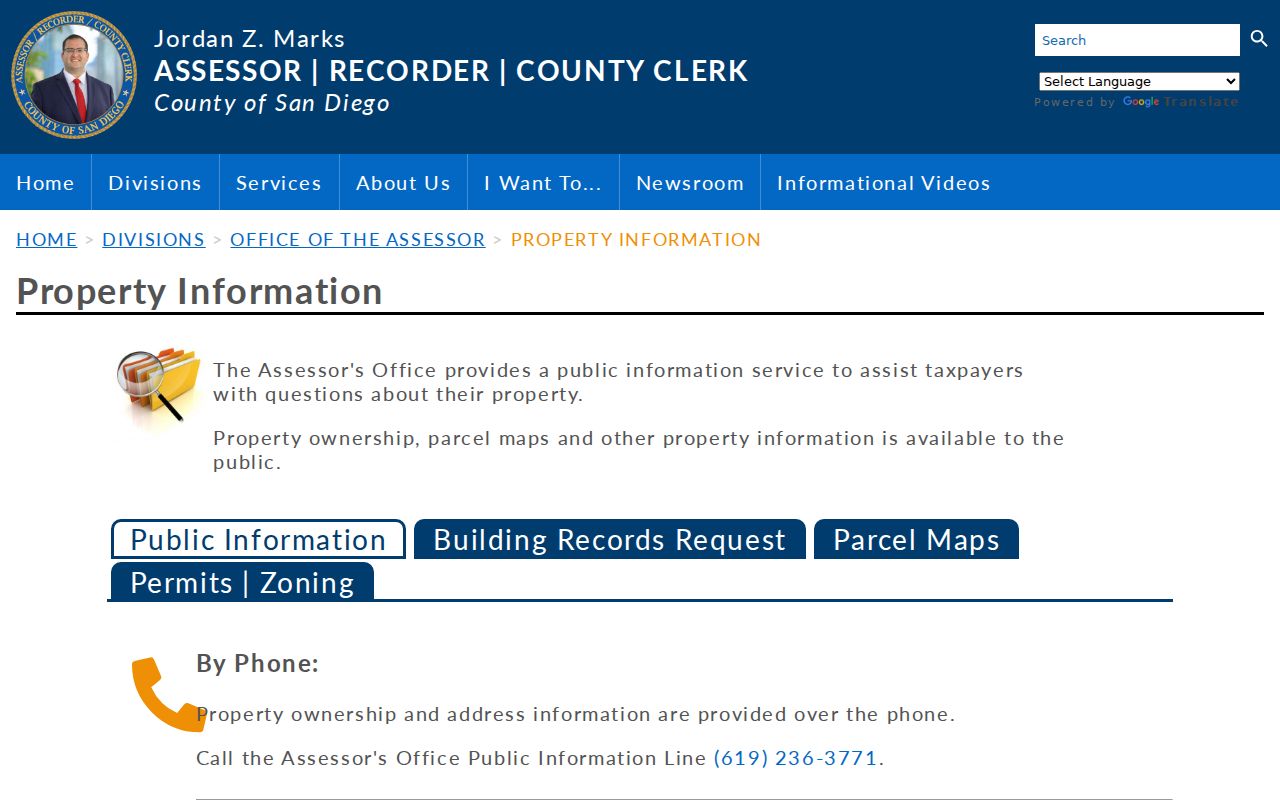
The county property page for Coronado is the bridge from a street search to ParcelQuest maps, characteristics, and the in-person ownership channel.
Which Coronado Street Records Follow a Block
A Coronado address guide is most useful when each record set is assigned its true scope. The Coronado assessment roll follows taxable parcels. The parcel map follows geometry and APNs. The deed index follows recorded parties and instruments. City permits follow project addresses and named applicants. Historical directories follow people who were printed at an address in a particular year.
| Record set | Keeper | Street result | Access |
|---|---|---|---|
| Coronado secured assessment roll | San Diego Assessor | APN, situs, values, exemptions | Free web search; no Coronado owner names online |
| Coronado ParcelQuest / parcel map | County property-records channel | Lot outlines and adjacent APNs | Basic map online; fuller Coronado kiosk access |
| Coronado Official Records Index | ARCC Recorder | Grantors, grantees, instruments, dates | 1970-present; Coronado APN search at kiosks |
| Coronado permits and plans | Coronado City Clerk / Community Development | Project, permit, applicant, inspection, retained plans | Monthly PDFs, counter, or focused CPRA request |
| Coronado printed directories | Libraries and archives | Dated occupants, spouses, occupations, addresses | Digitized selections and Coronado in-person collections |
| Coronado voter information | Registrar of Voters | No general public street list | Self-lookup or permitted statutory file |
The list also explains why a Coronado address guide can have gaps. A Coronado parcel can have an owner but no public occupant line. A permit can name an applicant or contractor who never lived there. A directory can lag a move. A voter address is protected except for statutory purposes. Treat each row as a different answer.
Map Adjacent Coronado Street Parcels
Use the ParcelQuest Lite or parcel-map entry from the county property-records page for Coronado. Search the target address or APN, pan and zoom to the street, select the parcel polygon, and write down the APN. Then select each touching polygon one at a time. The visible Coronado map supplies boundaries, geometry, and parcel relationships. It does not create a household list and should not be treated as a live owner layer.
For a Coronado block study, keep a row for each parcel: modern situs, APN, legal lot or subdivision, Coronado owner obtained through Assessor staff or a kiosk, mailing address, current deed reference, permit history, historic designation, and directory or census occupant by year. If a value is unknown, leave it unknown. That habit prevents a nearby parcel from being assigned the wrong person.
- APN
- An assessor parcel number, used as a tax and map key.
- Situs address
- The physical location of the taxable property.
- Legal description
- The lot, block, subdivision, or other land description used in recorded instruments.
- Plat
- A recorded map that lays out lots, blocks, streets, or easements.
A Coronado parcel map can show that parcels touch. It cannot show who greets a neighbor, who occupies a unit, or who is home today.
Keep Coronado Street Addresses Separate
Every serious Coronado street directory keeps two address columns. Coronado situs identifies the building or land. The owner mailing address is where a tax notice or property correspondence goes. They may match, but they may also differ because of a trust, a second home, a non-owner occupancy arrangement, an administrative address, or a parcel owner who lives elsewhere. A matched pair supports a clue, not a conclusive statement of owner occupancy.
Recorded documents may identify a legal description rather than the postal form. Early directory entries may say “cor Fifth and Orange,” “G ave bet Third and Fourth,” or “res at hotel.” Coronado modern postal tools normalize street types and ZIP codes, while old records preserve their own language. Search “Coronado Beach” as well as “Coronado” when a historical property or resort name appears.
For the same Coronado reason, an owner name is not a list of everyone who lives at the Coronado situs. Non-owner occupants, children, roommates, guests, and protected households may not appear in the assessment or deed file. The street directory should state the record role exactly.
Build a Coronado Street Deed Chain
Once Assessor staff or a kiosk supplies the current Coronado owner, search that name as grantee in the ARCC Official Records Index. A Coronado grantee receives an interest. The acquisition document’s grantor becomes the next prior-owner candidate. Repeat the search backward, checking date, document type, legal description, and APN where available. This is the cleanest way to move from a current parcel toward previous owners.
- Normalize the owner’s full name, middle initial, trust styling, and likely spelling variants.
- Search the name in the 1970-present index and narrow by deed, date, and location where possible.
- Open or order the instrument, noting document number, recording date, grantor, grantee, legal description, and page count.
- Use the prior grantor as a new grantee candidate, then validate the same land description.
- For years before 1970, move to recorder books, microfilm, archives, directories, newspapers, and CHA property files.
The Coronado ARCC recording gateway explains the Official Records path. After December 9, 2024, web APN searching for Coronado is gone, but county-office kiosks serving Coronado retain that key. Name searches and copy requests remain useful, yet a complete chain may require counter work.
Use a Coronado Street Kiosk for APNs
The APN change is one of the most important Coronado street directory facts. ARCC removed APN searching from its online Official Records Search on December 9, 2024 because of AB 1785. The county retained APN search at five office kiosks. That means a researcher who begins with a Coronado street and wants every deed tied to a parcel may need to combine the free web index, an Assessor call, and an office visit.
At the Coronado kiosk, validate a candidate deed against the Coronado property legal description and APN. If a record matters, order a copy or use the recorder’s copy channel. The normal index fields remain recording date, document number, document type, grantor and grantee roles, book and page for applicable older entries, page count, and indexed references. An index entry is not an image.
This temporary-looking inconvenience is now part of the stable Coronado workflow. A Coronado street directory that says only “search the web” misses the county’s actual access channel for Coronado records.
Review the Coronado Assessor fee schedule before traveling, because office access and fees can change.
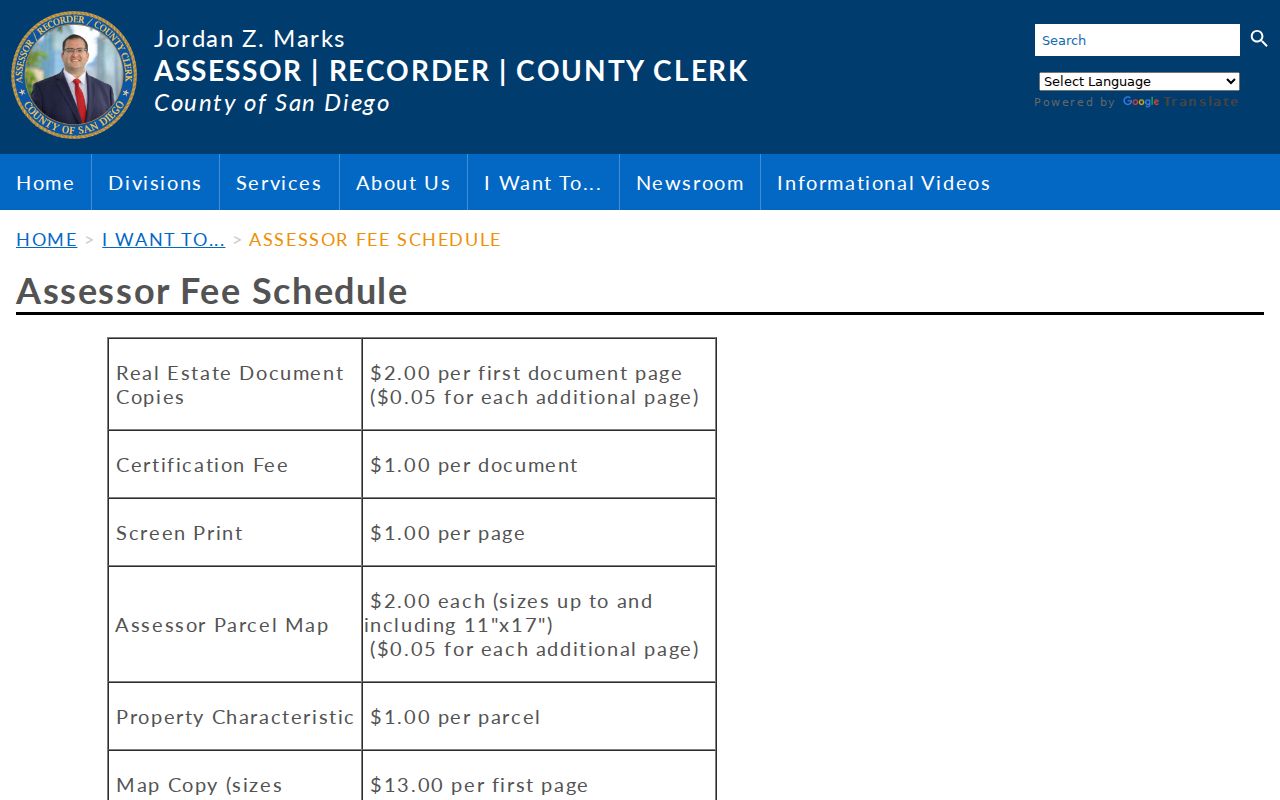
The Coronado Assessor fee reference shows the small, specific costs for a Coronado map, screen print, or characteristic sheet used to support a street record.
Layer Coronado Street Permits and History
Coronado Building Services publishes monthly Issued Permits PDFs from January 2024 through July 2026. Search a Coronado month by address, owner, applicant, or contractor, then request the underlying permit or Coronado inspection file. Building Services at 1825 Strand Way handles permit business Monday through Friday from 8:00 a.m. to 4:30 p.m.; the permit number, project address, inspection type, requested day, time window, contact name, phone, and remarks are the practical fields used for inspection requests.
Coronado plans and permits can be inspected or reproduced under Health and Safety Code §19851, but the city government in Coronado does not retain every original plan. Copyrighted or sealed plans may require notices or permissions. A permit applicant, owner, contractor, designer, or contact is not automatically a resident. Use the Coronado role printed in the file.
Historic-resource designations and Mills Act agreements add another Coronado address-linked layer. The city’s adopted historic context statement, Coronado Historical Association property files, photographs, and the Photo Atlas can explain why a building or name appears in a record. They are Coronado history evidence, not a current occupancy roll.
Browse the Coronado Building Services permit page for the monthly index.
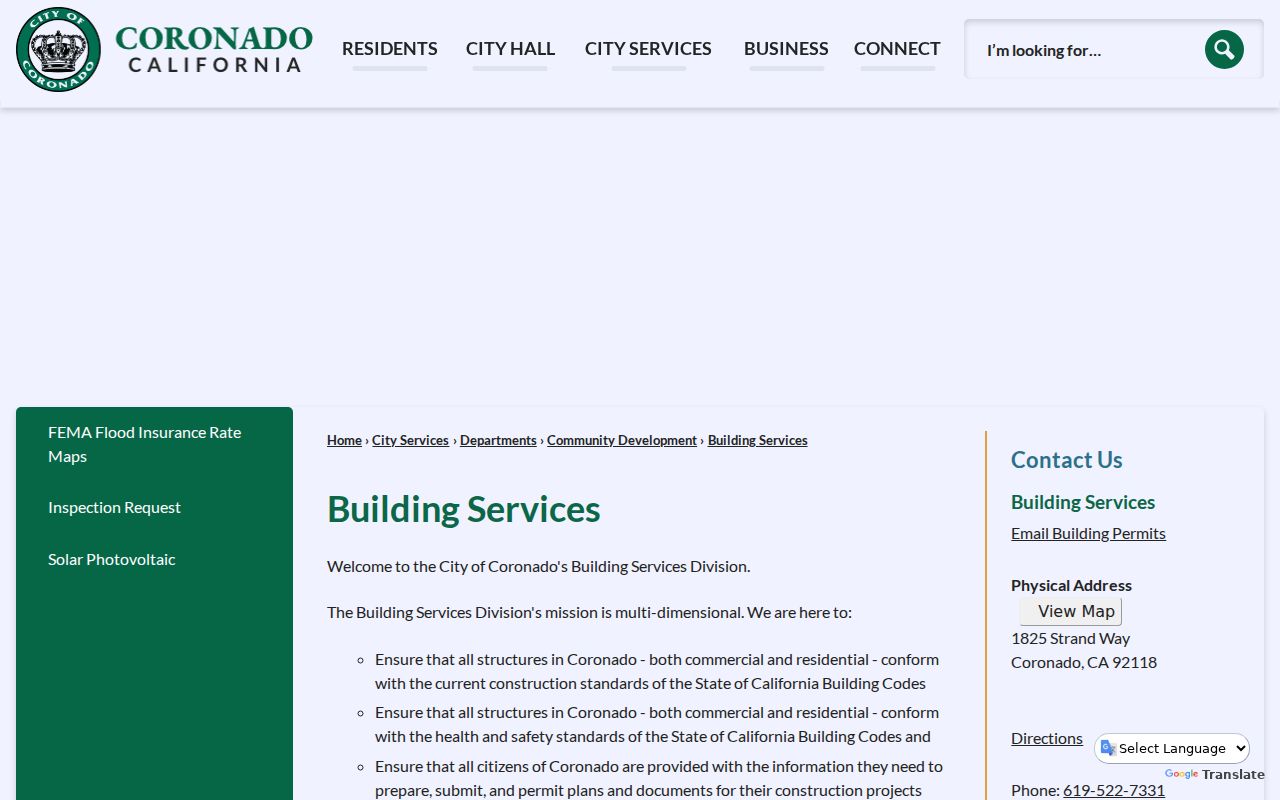
The Coronado permit page shows the month-by-month route from an address to a retained project file.
Read Coronado’s Unusual Street Grid
Lettered avenues and numbered streets make manual browsing possible, but named curves and waterfront areas complicate a simple sequence. Orange Avenue is a commercial spine. Glorietta and Pomona curve through the older setting. Alameda, Ocean, and Encino need name-based navigation. Silver Strand and Coronado Cays carry a different planned-community context, while Naval Base Coronado introduces federal parcels and mailing patterns unlike ordinary residential lots.
Historical sources may use “Coronado Beach,” a hotel, an intersection, or a between-streets description. The 1892-93 directory includes forms such as “cor Fifth and Orange ave” and “G ave bet Third and Fourth.” Preserve those exact clues. Do not guess a modern street number from an old phrase. Use a period map, directory page, Sanborn footprint, and legal description together.
When a Coronado street appears to change, the research file does not supply a complete authoritative renumbering concordance. Use city or CHA property files before declaring two address forms continuous. A careful street directory can be slower and more accurate than a fast normalization.
What a Coronado Street Search Cannot Identify
A Coronado street directory can identify parcels, owners obtained through the proper channel, recorded parties, permit roles, and dated historical occupants. It cannot provide a public list of current non-owner occupants, guests, children, household members, utility customers, or DMV addresses. The voter file is restricted under Government Code §7924.000 and Elections Code §2194. Motor-vehicle information is protected by the federal DPPA. A confidential or substitute address may also prevent a usual street match.
For a Coronado search, do not turn a mailing address into a residence claim, a deed party into an occupant, or a code complaint into proof of a violation. Code Enforcement complaints identify a problem address and keep complainant identity confidential; a releasable case must be requested through the clerk. Public association contacts can help with community history, but private rosters are not a general directory.
Lawful use. Coronado street and address records are for personal, lawful research, family history, and property curiosity. Repeated malicious following or harassment can violate California Penal Code §646.9 and civil-harassment law. Never use a street search to stalk, intimidate, or harm a person.
Bridge Coronado Street Postal Descriptions
A final Coronado street directory check compares four identifiers: situs address, owner mailing address, APN, and legal description. USPS standardizes delivery and ZIP+4. The assessor keys the parcel on situs and APN. The recorder relies on parties and legal descriptions. A library directory may print a household at an intersection or abbreviated street form. The same place can therefore look different in four systems.
When a Coronado street search reaches 92118, verify delivery through USPS, then use the county parcel and city jurisdiction records for the governmental location. A PO-box-only 92178 address cannot be mapped to a dwelling. This distinction belongs in any address trail that crosses the Village, Shores, Cays, Silver Strand, or federal parcels.