
Coronado Sources for Previous Residents
A Coronado previous-residents search works across eras. Deeds show recorded transaction parties. City directories show published occupants and occupations. Census schedules show a counted household. Sanborn maps show the building footprint and use. Permits show project roles. Obituaries and probate can connect a past occupant to a family or estate. The strongest trail uses more than one row.
| Source | Years covered | Where held | What it shows |
|---|---|---|---|
| Coronado Official Records web index | Coronado 1970-present | San Diego County ARCC | Coronado owners, transfers, liens, easements, and recorded parties |
| Coronado city and county directories | 1886-2021 overall; verified Coronado 1926, 1928, 1934, 1958 | Coronado SDPL and digitized collections | Coronado occupants, spouses, occupations, and addresses |
| 1892-93 Coronado directory | Coronado 1892-93 | Internet Archive | Coronado intersections, hotels, businesses, and early local names |
| Coronado federal census | Coronado through 1950 public as of 2026 | NARA, libraries, and genealogy databases | Coronado household members, relationships, ages, and birthplaces |
| Coronado Sanborn maps | Coronado 1906 digitized; building sources cite 1888, 1921, 1949 | Library of Congress and heritage files | Coronado footprint, material, use, and street context |
| Coronado permits and plans | Monthly issued PDFs January 2024-July 2026; older archive exact start not stated | Coronado City Clerk and Community Development | Coronado construction, alterations, applicants, and retained plans |
The Coronado table prevents a common error. A deed party is not automatically an occupant. A directory line is not a title record. A map does not name a household. A permit applicant may be an owner, contractor, designer, or contact. Write the Coronado source role beside every name.
Start With a Coronado Previous Resident APN
Normalize the modern Coronado address, then run it through the San Diego secured assessment roll or the county parcel map. Record the APN, situs, legal subdivision, and nearby parcel numbers. The web assessment result shows values and exemptions but not owner names. Ask Assessor Public Information at 619-236-3771 or use a county kiosk to obtain ownership and mailing context.
Keep the Coronado owner mailing address separate from the situs. A trust, second home, off-island owner, or administrative address can create a mismatch. Matching addresses support a clue, not proof that the owner occupied the property. Once the APN and current owner are anchored, the deed chain can begin.
- APN
- The assessor parcel number used to identify taxable land and map geometry.
- Situs
- The physical property address.
- Legal description
- The lot, block, subdivision, or other land language used in a recorded instrument.
- Chain of title
- A sequence of recorded transfers that connects one ownership interest to earlier interests.
The current Coronado property record is the anchor, not the first previous resident. That distinction keeps the later household trail honest.
Walk the Coronado Previous Residents Deed Chain
The Coronado ARCC Official Records Index lets a researcher search grantor and grantee names, document type, recording dates, and document number. A grantee receives the interest. A grantor transfers it. Find the current owner as grantee, confirm the legal description, then use the deed’s grantor as the earlier candidate. Repeat until the online trail reaches its boundary.
- Search the current owner with middle initials, trust styling, and spelling variants.
- Record the document number, date, type, grantor, grantee, legal description, and APN reference.
- Use the prior grantor as a grantee candidate in an earlier date range.
- Validate each hit against the same land description instead of relying on a street name alone.
- Order the relevant image or continue at the county kiosk when the index is not enough.
Coronado index coverage begins in 1970. Copies cost $2 for the first page plus $0.05 per additional page, with certification at $1. Sensitive numbers are redacted, and Government Code §27301 provides an SSN-redaction request route for official records. The Coronado recorder’s recording page is the current gateway.
Cross the Coronado Previous Residents 1970 Cutoff
On December 9, 2024, ARCC removed APN search from the Coronado web Official Records Search, while keeping APN access at five county-office kiosks. Name-based web work remains available, but an address-first chain may require a phone call to the Assessor, a kiosk visit, and a recorder copy request. This is a practical access change, not a missing history.
For pre-1970 work, ask the recorder about older books, indexes, microfilm, or archives. Then bring in the San Diego Public Library directory shelf, newspapers, CHA property files, and Sanborn maps. A search that stops at 1970 is incomplete for a historic Coronado property.
Use the Coronado ARCC Official Records notice to check the current web and kiosk path.
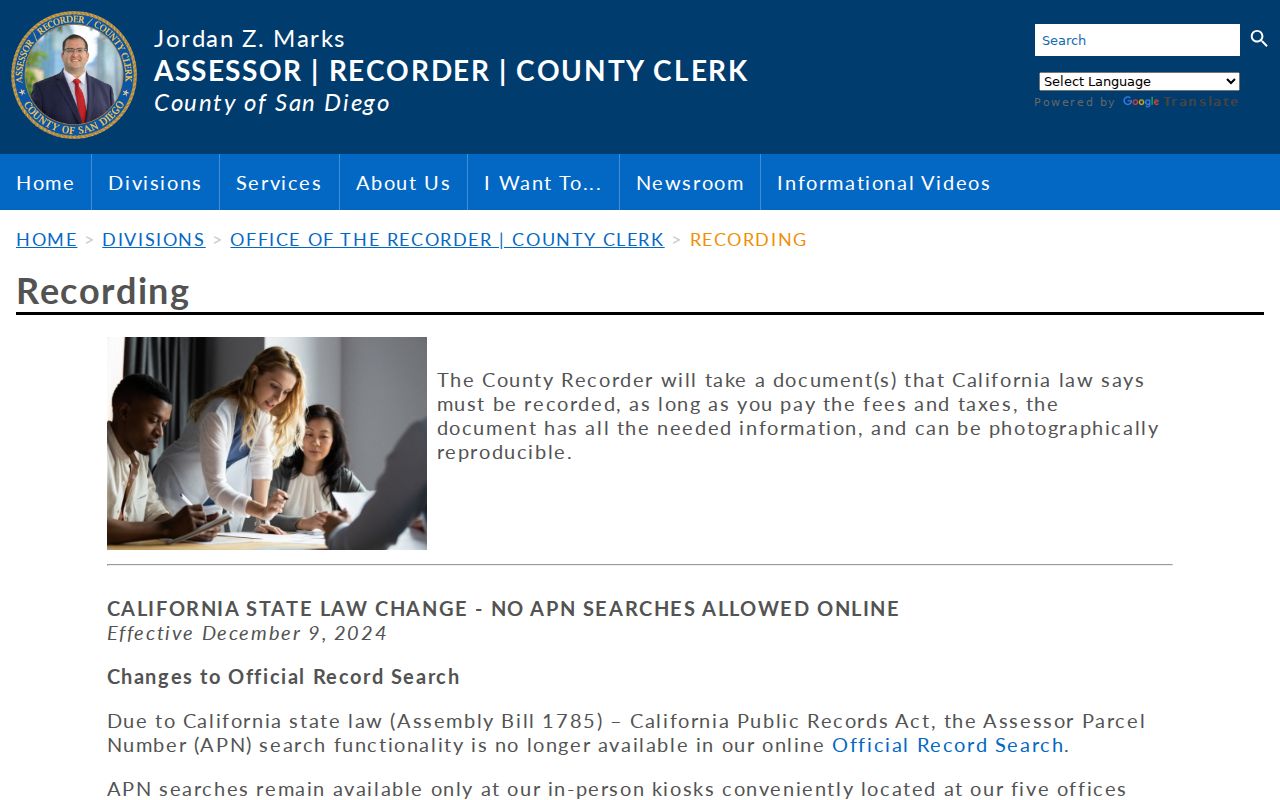
The Coronado recorder page captures the transition from web APN search to the continuing county-kiosk channel.
Search Coronado Directory Years for Previous Residents
Ownership is only half of the previous residents question. San Diego Public Library’s directory run spans 1886-2021, with verified Coronado sections in 1926, 1928, 1934, and 1958. The 1934 format can show surname, given name, spouse, occupation or rank, employer, “h” home marker, “r” residence marker, address, and “wid” notation. The 1892-93 volume uses a different grammar, including corners, between-street phrases, hotels, and business roles.
Search the address and the surname. If a name disappears, check the next year, a reverse or street section, the old address, newspapers, and military or hotel clues. Coronado’s USN entries make reassignment a real explanation. A hotel or resort address can describe a business or boarding link, not ownership. The full collection method belongs on the Coronado city directory page.
Preserve Coronado entries as printed. “Cor Fifth and Orange” and “G ave bet Third and Fourth” are evidence forms, not errors to normalize without a period map.
Pair Coronado Previous Residents With Census Schedules
Federal census schedules through 1950 are public as of 2026. Pair Coronado directory decades with the 1900, 1910, 1920, 1930, 1940, and 1950 schedules. The directory may show an address, spouse, occupation, or boarder marker. The census can add household relationships, ages, and birthplaces. If the two sources disagree, retain both and investigate the date, address form, and publication lag.
The 1890 federal census loss makes the 1892-93 Coronado directory especially valuable. It appeared shortly after incorporation and preserves a municipal roster and personal lines. Use it as a local near-period bridge, then corroborate with newspapers, deeds, or later volumes. A directory line can lag a move; a census can count a household on one day. Neither is a complete residence ledger.
For a past Coronado household, write an evidence row with source, year, name, address, household role, and confidence. Do not infer present residence from a historic entry.
Read Coronado Previous Residents Through Sanborn Footprints
The Library of Congress has a digitized 1906 San Diego volume naming Coronado Beach. Historic-building documentation also cites 1888, 1921, and 1949 Sanborn footprints. Sanborn maps can show building shape, materials, use, street context, and changes over time. They do not name the people who lived in a building.
Use a Coronado Sanborn sheet to test whether an old address, building form, or named property fits the modern parcel. Pair the footprint with a directory entry, census schedule, deed legal description, permit, or CHA photograph. Hotel, Tent City, and resort names can be more stable than a street number in the oldest sources.
A Coronado map may explain why a directory entry says hotel, boarding, or business. It should not be used alone to identify a previous resident. The map is a building and land-use layer in the chain.
The Coronado 1906 resource is available through the Library of Congress Sanborn collection.
Date Coronado Previous Residents With Permits
Coronado Building Services publishes monthly Issued Permits PDFs from January 2024 through July 2026. Search a month by address, permit, applicant, owner, or contractor, then request the underlying file. Building Services at 1825 Strand Way handles permit business Monday through Friday, 8:00 a.m. to 4:30 p.m. The inspection line uses permit number, project address, inspection type, requested day, AM or PM window, contact name, phone, and remarks.
Coronado plans and building records are available for inspection or reproduction under Health and Safety Code §19851, but the city does not retain every original plan. Copyrighted or sealed plans may require notices or permissions. A permit applicant or contractor is not automatically a resident. Preserve the Coronado role shown in the file.
For an older or unlisted Coronado record, send a focused request to the City Clerk through JustFOIA, by email, mail, phone, or in person. Give the address, APN if known, permit number, record type, date range, and contact details. The City Clerk coordinates permanent archives, but cannot promise immediate duplication.
Review the Coronado Building Services page for the current monthly permit path.
Finish Coronado Previous Residents Research With Probate
Obituaries and death notices can connect a directory occupant to a spouse, child, estate, or later location. Coronado Public Library identifies HeritageHub, the San Diego Union run, and the California Digital Newspaper Collection as useful lead sources. The local newspaper gap from 1896 through 1915 makes the Union and Evening Tribune especially important for that interval.
Coronado probate files can identify a decedent, petitioner, personal representative, heir, or property interest. The San Diego Superior Court Civil, Small Claims, and Probate Register of Actions provides summaries; official files and courthouse kiosks supply the stronger evidence. A newspaper or obituary is a lead, not a substitute for the official death or probate record.
When an obituary names a former Coronado address, compare the date with the directory, deed chain, and census. A later survivor or heir may appear in probate without ever having lived at the house. Preserve that distinction.
Bridge Coronado Previous Residents and Historic Names
Coronado’s late-nineteenth-century resort development explains why older records say “Coronado Beach,” Hotel del Coronado, Tent City, rail, ferry, or named hotel. Search those terms with a surname and a modern address. For early entries, preserve intersections such as Fifth and Orange or G Avenue between Third and Fourth. For a trust-held parcel, search the full trust styling, trustees, abbreviations, and successor documents.
Coronado lettered avenues, numbered streets, Orange, Glorietta, Pomona, Alameda, Ocean, Encino, the Village, Shores, and Cays all create useful geographic filters. But the research does not supply a complete authoritative street-renumbering concordance. City and CHA property files should be consulted before asserting continuity between an old and modern address.
The result is a defensible Coronado previous-residents trail: current APN, recorded owners, historical occupants, building evidence, and closing family or estate clues, each marked with its Coronado source and date.
Lawful use. Previous-resident research in Coronado is for house history, genealogy, and personal curiosity. Do not use a historic address trail to stalk, harass, track, intimidate, or harm a living person.