
Begin With the Right Coronado Record
A Coronado residents directory search works best when you know what each record can prove. An assessor record locates a parcel, shows its assessed value, and ties an owner to a mailing address. That owner link comes through staff or a kiosk. A recorded deed links named parties to a transaction. Court indexes link a name to a filed case, not to a charge or outcome. A city directory entry gives a year-specific residence, occupation, spouse clue, or address. These are different kinds of evidence.
Always use the narrowest source that answers the question. For a present-day parcel, begin with the San Diego County Assessor's secured roll. The ParcelQuest map also works. For a person's court history, search the San Diego Superior Court index, then inspect the official file. For a family event, order the correct copy from San Diego County ARCC. Birth, death, and marriage records can also come from the California Department of Public Health. For a past household, start with the San Diego Public Library's city-directory collection. Then work across editions.
- Write down the name, address, likely date, and any spelling or military-rank variant.
- Use the county assessment roll or parcel map to anchor an address or APN.
- Cross-check a name in the recorder, court, business, license, or historical index that fits the question.
- Read the result as an affiliation, transaction, household snapshot, or event, not as proof of every occupant.
- Ask the custodian for the file, copy, or correction when an index is incomplete.
That order keeps a Coronado residents directory search honest. The public trail has real gaps. It can miss non-owner occupants, household members, protected voters, people using a substitute address, and anyone the particular record set never captured.
Where Coronado Resident Records Live
Coronado is an incorporated city, but San Diego is the county seat. The split matters. Coronado City Hall coordinates city-created files and routes requests through its clerk. San Diego County ARCC holds the deeds, recorded instruments, and property information. It also keeps vital certificates, marriage licenses, and fictitious business names. San Diego Superior Court keeps the civil, criminal, family, and probate files. The Registrar of Voters guards registration information under special confidentiality rules. The library and the Coronado Historical Association offer historical context. They do not provide a current household roll.
San Diego County ARCC Recorder / Clerk
County deeds for Coronado, recorded instruments, vital certificates, marriage licenses, and FBN filings
619-237-0502
Coronado Recorder / Clerk services
San Diego County Assessor
Coronado parcel, address, assessed-value, map, ownership, and mailing-address channels
619-236-3771
Coronado property records and maps
San Diego Registrar of Voters
Coronado own-registration verification and statutory-purpose voter-file requests
858-565-5800
Coronado Voter Information Lookup
Coronado City Clerk
Coronado permits, plans, council files, disclosures, business records, and city CPRA coordination
619-522-7320
Coronado JustFOIA requests
When calling about a Coronado name, name the office before the person. The same name can surface in a deed, a permit, a city staff listing, and a court index for unrelated reasons. The custodian's role is your first disambiguator. The city's Coronado JustFOIA portal gives residents a way to submit and track records requests.
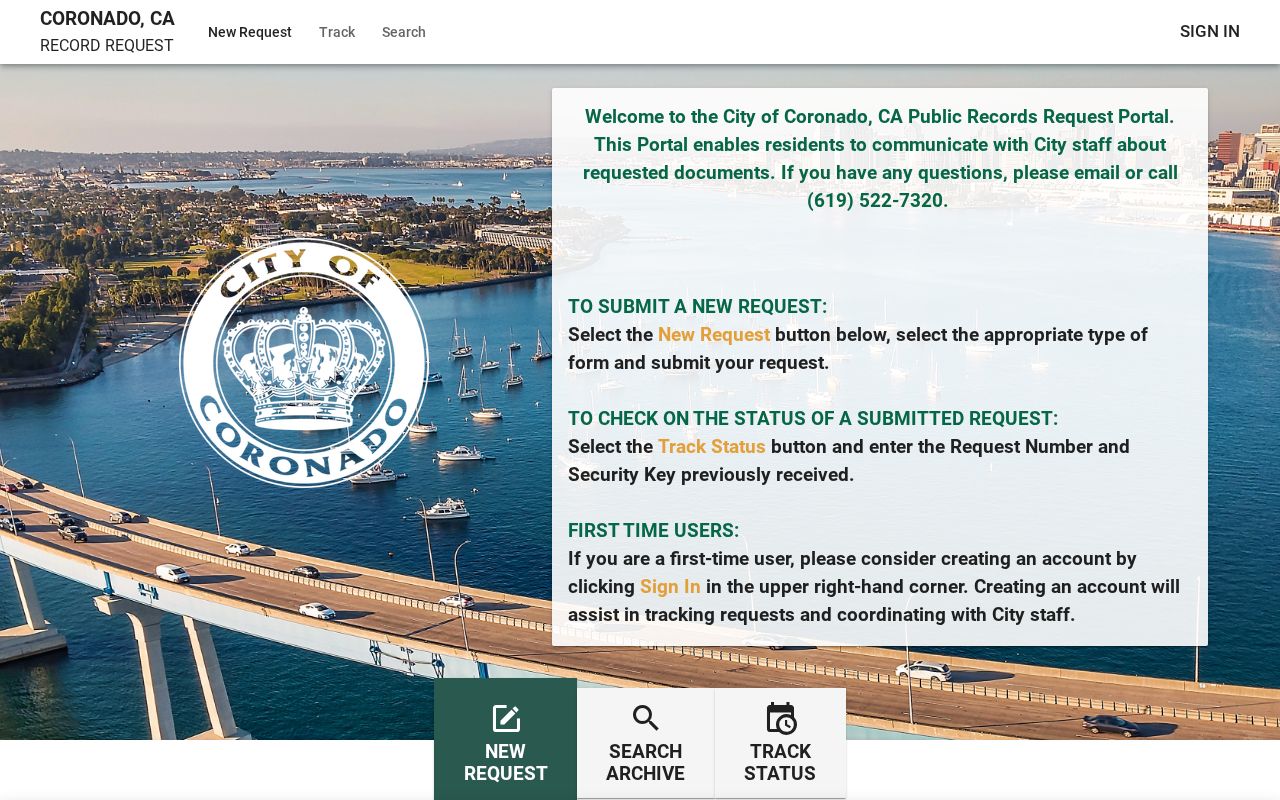
The Coronado request portal is a city access channel, separate from the county systems that hold deeds and property ownership.
Coronado Assessment Records by Address
The San Diego secured assessment roll is a strong first stop for a Coronado address. It accepts an APN, a street address, or a street name. Street Name mode helps when a parcel lacks a street number. It also works when you are moving along a block. Results can show the APN and situs. They list land and improvement values, total assessed value, exemption amount, lien date, and year. Owner names stay offline under California's privacy rules.
| Search field | How it helps |
|---|---|
| Parcel Number | For a Coronado parcel, use the full format 123-456-78-90, with at least eight digits. |
| Address | Locate a Coronado situs by street number and name in Coronado. |
| Street Name | Find Coronado parcels along a named street when the number is unknown. |
| Result values | Compare Coronado APN, situs, assessed values, exemptions, lien date, and year for Coronado. |
| Owner detail | Ask Assessor Public Information about a Coronado owner by phone or use a Coronado public kiosk. |
For a Coronado parcel, the phone and counter channel changes what you get. Assessor staff can release ownership information. They can also release address information. Kiosks allow fuller property access. A screen print costs $1, a parcel map $2, and a characteristic sheet $1. Keep the owner mailing address separate from the property situs. A match can suggest owner occupancy, but it cannot prove who is inside the building.
To see the county interface for Coronado before searching, open the secured-roll search page. The map and basic property channel are reachable through the county property-records page.
Coronado Recorded Documents From 1970
Coronado deeds and liens sit in the ARCC Official Records Index, which reaches back to 1970. Deeds of trust, reconveyances, releases, easements, liens, notices, maps, and other recorded instruments all appear in it. Search by grantor or by grantee. A document type or date range narrows things down. When a result opens, record the document number, the date, each party's role, the legal description, and any APN reference. The grantor gives or transfers an interest. The grantee receives it.
An index hit is not the document itself. It proves named parties took part in a recorded instrument, nothing more, so a name in the Coronado index does not guarantee that person lived at the address in question. Copies cost $2 for the first page and $0.05 for each added page. Certification adds $1. Request copies through the recorder's channels or at an office. Sensitive numbers get redacted from public copies. Under Government Code §27301, anyone can ask that an SSN be redacted from an official record while the confidential original stays preserved.
One access change trips up many Coronado lookups. Web APN searching left Official Records on December 9, 2024. APN search still works at five county-office kiosks. A name-based web search remains useful, but a clean address chain may take an Assessor APN, a kiosk visit, and a copy request. The ARCC recording page posts the current gateway and notice.
Research shortcut. For a Coronado parcel, start with the present owner obtained through Assessor staff or a kiosk, find that person as grantee, then follow each earlier grantor backward.
Coronado Court Index for Resident Records
Coronado has no separate municipal court record set for ordinary Superior Court matters. The San Diego Superior Court's Court Index covers civil, criminal, family, mental-health, and probate filings. Party Name, Case Number, and DA Number modes are all offered. Case type and court-location controls refine the search. Long-form case numbers go in as the year plus the eight-digit sequence, with no dashes.
| Visible result | What it tells you | What it does not tell you |
|---|---|---|
| Coronado case title and number | Connects a Coronado name to a filed matter. | Not proof of the charge or outcome. |
| Coronado facility and case type | Shows Coronado court location and record category. | Not a complete countywide history. |
| Coronado filing date and parties | Supplies Coronado time and party-role clues. | No charges or disposition in the index. |
Exclusions matter in Coronado research. Cases before 1974, juvenile matters, and some traffic and minor-offense records stay out of the index. Civil, small-claims, and probate Registers of Actions add filing and proceeding summaries. Some document images dated after January 1, 2008 can be purchased online. Courthouse kiosk viewing is free. Federal matters belong in PACER for the Southern District of California.
Match the full name, the date, the location, and the party role before calling a Coronado result relevant. A dismissed case can remain indexed. The index never says how a case ended. When the outcome matters, pull the official file. The public Court Index entry opens the search screen.
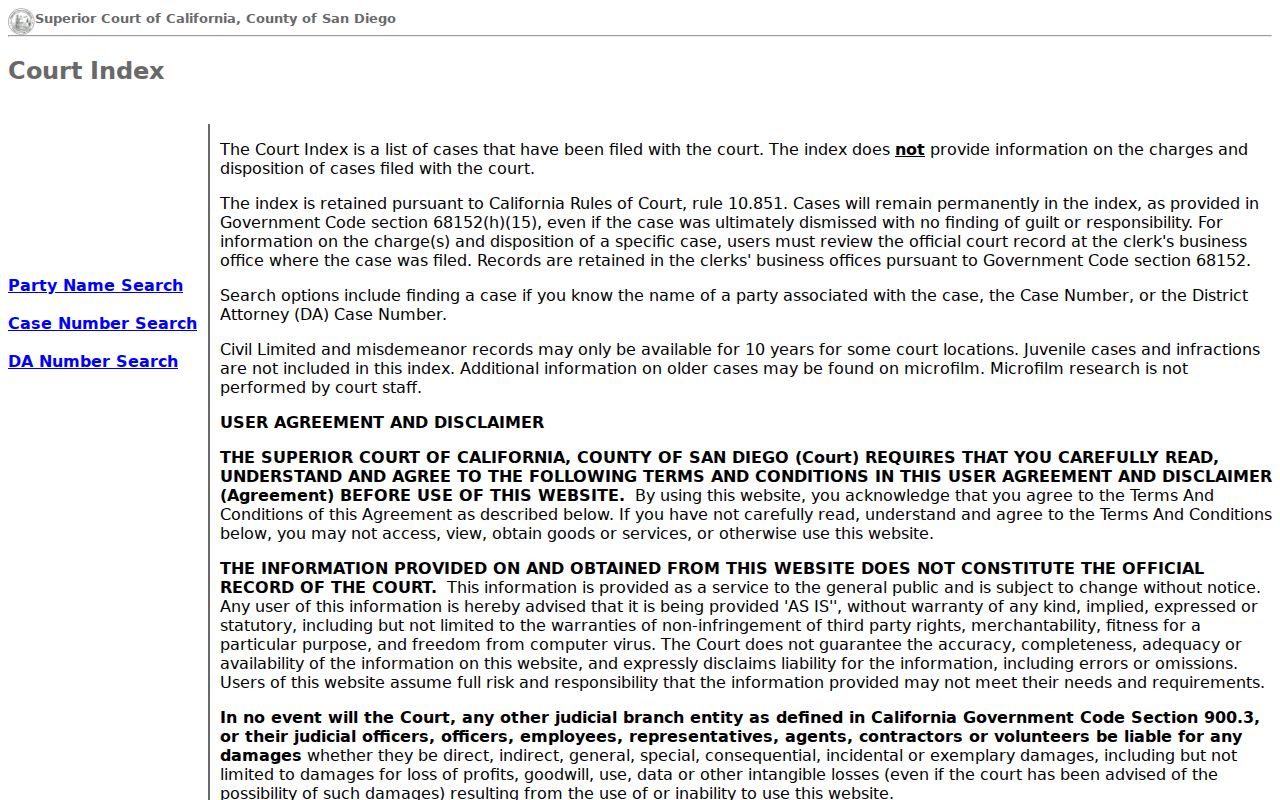
The Coronado court search screen displays the search modes clearly, but any result still needs verification against the court file itself.
Coronado Voter Records Are Not a Directory
The Coronado Voter Information Lookup verifies a voter's own registration and ballot details. It asks for several fields. These include party preference, house number, birth date, street direction, street name, street type, and ZIP code. It is not a public name query. A no-match notice may just reflect a different entry in the file. The spelling of the address, the birth date, or the ZIP could differ.
A voter file can hold a name, residence or mailing address, party preference, status, registration date, precinct and district information, and participation history. Government Code §7924.000 and Elections Code §2194 keep home street address, phone, email, voter numbers, prior registration, identification numbers, and signature confidential. The exception is permitted purposes. Private or commercial use, harassment, solicitation, and internet republication are all prohibited. A statutory-purpose file application exists. But it is not a lawful way to browse a Coronado block.
Use the county lookup for your own registration only. A voter record is not a general Coronado residents directory. Never infer that a registered voter owns the home or is the only person there. The county self-check form for Coronado is documented at the Voter Information Lookup page.
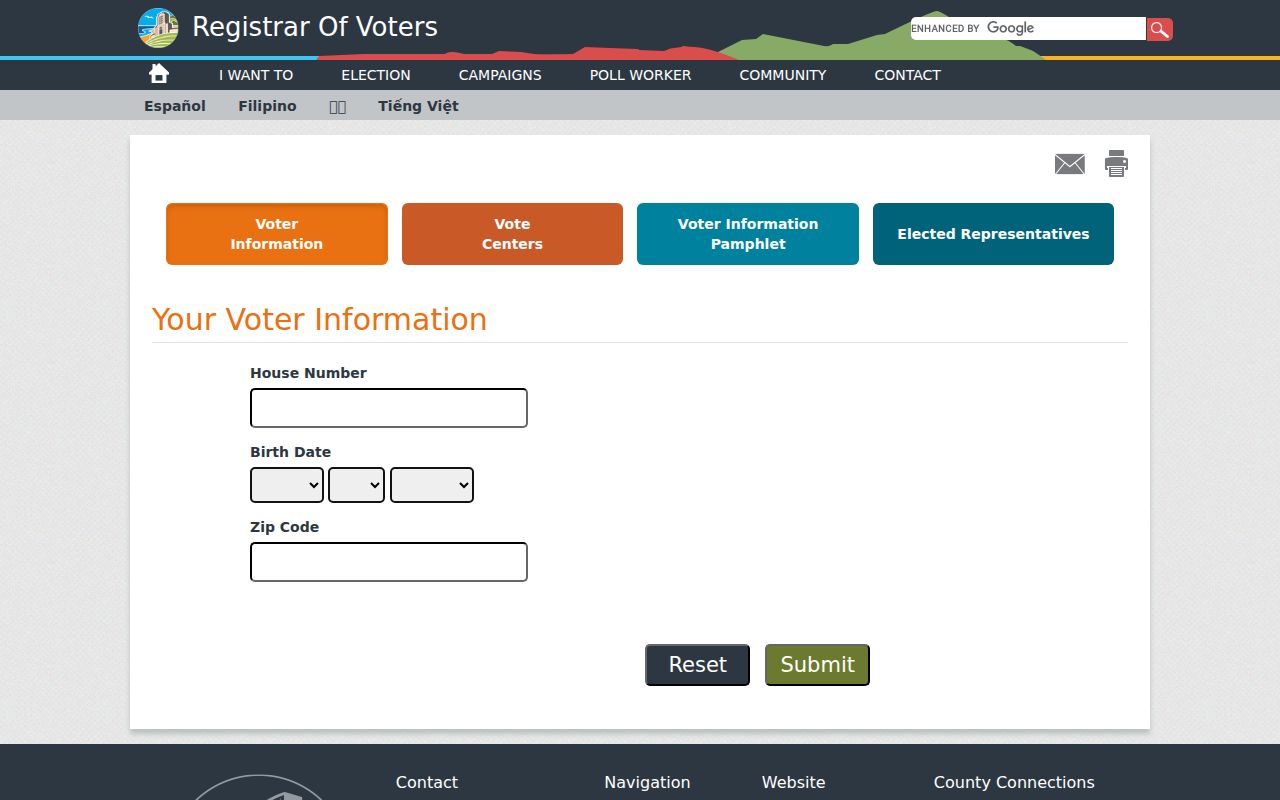
The Coronado voter form shows why address and birth date work as identity checks rather than public browsing fields.
Coronado Vital Records and Copy Rules
San Diego County ARCC issues birth, death, and marriage certificates for Coronado events. CDPH Vital Records serves as the statewide fallback. California has no simple rule opening every certificate after a fixed span of years. Health and Safety Code §103526 splits authorized certified copies from informational copies. Authorized copies go to listed relationships, representatives, certain agencies, or a court-order path. Informational birth, death, and nonconfidential-marriage copies are generally available to others once the record qualifies. Confidential marriage access is narrower, usually the registrant or a court order.
| Record | Custodian and 2026 county fee | Access note |
|---|---|---|
| Birth | Coronado ARCC or CDPH, $34 | Coronado authorized copy rules apply; county records are usually available about three weeks after the event. |
| Death | Coronado ARCC or CDPH, $26 | Coronado eligible parties may obtain an authorized copy; others may qualify for informational access. |
| Nonconfidential marriage | Coronado ARCC, $19 | Coronado authorized and informational routes differ. |
| Confidential marriage | Coronado ARCC, $19 | Coronado registrant or court order, with a possible existence letter route. |
Coronado in-person orders need valid identification. Cash, check, money order, or card all work, with a $2.50 card add-on. Mail orders take a check or money order payable to San Diego Recorder/County Clerk. An authorized-copy request adds a notarized sworn statement. Online VitalChek adds a $12.95 handling charge plus optional $19 expedited service. Search fees stay due even when the office issues a Letter of No Record.
Current Coronado Sources Answer Different Questions
No lawful current Coronado residents directory lists every household. The closest sources each carry distinct keys and limits. The comparison below keeps an owner, voter, party, staff member, association, or public-affiliation record from being mislabeled as a complete resident list.
| Source | People or places represented | Custodian | Access boundary |
|---|---|---|---|
| Assessment roll and parcel map | Coronado taxable parcels, owners through staff, values and maps | San Diego Assessor | Coronado web owner names suppressed; phone and kiosks help. |
| Official Records Index | Coronado grantors, grantees, and recorded instrument parties | ARCC Recorder | Coronado index is free; copies and APN kiosk work fill gaps. |
| Voter lookup | The requesting Coronado voter’s own registration | Registrar of Voters | No stranger name search; Coronado Elections Code limits apply. |
| City staff directory | Current Coronado municipal roles and contact points | City of Coronado | Coronado role or work contact, not residence proof. |
| Business and professional filings | Coronado agents, officers, licensees, and business addresses | SOS, DCA, city and county | Coronado public affiliation, not a household claim. |
Match the record to the question before you search. One Coronado person needs two independent facts. Think of a name plus an address-year, or a business filing plus a court location. A street question points to parcel and deed keys instead. Family history leans on historical collections and event records. The longest name list is not always the most useful record.
Lawful use. Coronado records support personal research, genealogy, and civic understanding. Do not use a name or address to stalk, harass, intimidate, or harm anyone.
Coronado’s Long Historical Directory Trail
The San Diego Public Library catalogs city directories covering 1886 through 2021. Two online groupings stand out. San Diego Yesterday spans 1887 through 1925. The San Diego City Archives covers 1925 through 1960. Later volumes live mainly in Central Library Special Collections. Coronado sits inside these metropolitan and county volumes as its own headed section. A catalog that says San Diego can still hold a Coronado entry. Do not skip it.
The 1892-93 Directory of San Diego City, Coronado and National City opens its Coronado section near printed page 23. Local examples survive for 1928, 1934, and 1958. A single 1934 entry can carry surname, given name, spouse, and occupation or rank. It may also list employer, home marker, residence marker, street number, and a widow notation in one dated snapshot. Treat it as evidence of a published tie to a place, not proof of ownership.
Coronado Library keeps a local-history collection of more than 20,000 items. That includes telephone directories, yearbooks, local magazines, maps, photographs, postcards, and ephemera. The Special Collections catalog shows only part of it, so book a reference appointment. The Coronado city directory page carries the full treatment of these holdings.
The digitized directory scan makes the 1892-93 volume reachable from anywhere. Historical research often ends in a city or county request. That happens once a useful item is known but sits outside every online index.
Coronado Military and Resort Resident Clues
Coronado history hands researchers unusually strong identity markers. Directory entries repeatedly show USN ranks and Hotel del Coronado occupations. A spouse in parentheses or a widow abbreviation can split two people sharing a surname. So can a named employer. Early entries sometimes give an intersection like Fifth and Orange, a between-streets phrase, or a hotel as the residence. Keep that wording as written rather than forcing it into a modern number.
Search both "Coronado" and "Coronado Beach." When a surname is common, add Hotel del Coronado, Tent City, the ferry, the railroad, the Coronado Beach Company, or a named hotel. A military man vanishing from one annual directory may simply face reassignment or deployment. Hospitality work can flag an occupation or business link. A hotel address is not automatically a home address.
The Village, Shores, Cays, Silver Strand, and naval parcels each create different record patterns. One compact city holds single-family blocks, high-rise condominium parcels, planned waterfront subdivisions, and federal land. Keep parcel evidence, directory evidence, and household evidence in separate columns.
Coronado Records When the Online Trail Stops
"Not online" does not equal "not available." An owner name may surface by phone or at an Assessor kiosk even when the web roll suppresses it. An APN deed search may work at a county kiosk after the web version was removed. A court index can omit a disposition that the official file supplies. The Coronado Library reference desk may hold telephone directories or yearbooks the catalog never fully represents.
City permits and plans start with the monthly Issued Permits PDFs from January 2024 through July 2026. Then ask Building Services or the City Clerk for an underlying file by address, permit number, APN, date, or project type. City Hall accepts JustFOIA requests in person, by mail, phone, email, or its tracked portal. CPRA determinations normally arrive within ten calendar days. An unusual-circumstances extension can add up to fourteen days in writing. Inspection is free, electronic delivery is generally free, and paper copies run $0.05 per page.
A focused Coronado request should name the record, time range, address, and likely department. It cannot override protected voter information, DMV data, confidential marriage records, juvenile or sealed files, utility accounts, or private association rosters. The custodian can release segregable material and withhold the protected portion.
The city's public-record request guidance and the JustFOIA portal show both access channels.
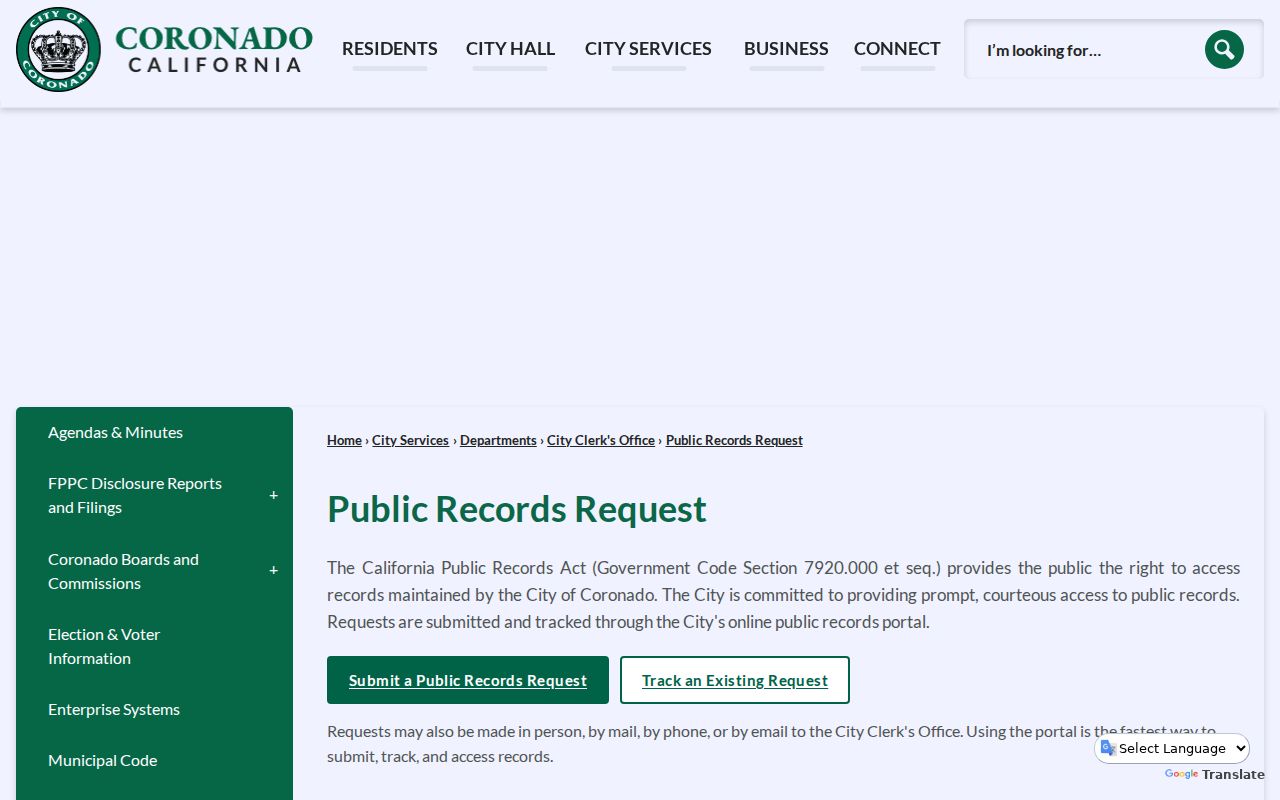
Coronado public-records guidance connects a known address or project to whichever office holds the retained file. The residents directory gives you the custodian; the custodian gives you the record.
Coronado Resident Address Privacy and Alerts
Coronado residents facing threats have a state option. California's Safe at Home Program, under Government Code §§6205-6216, provides a substitute mailing address for eligible survivors. It also provides confidential voter registration. Government Code §6208.1 can also restrict public display after a proper nondisclosure demand. A substitute address is not a public parcel key. Private and federal entities may not be required to accept it.
For monitoring Coronado recordings, San Diego County ARCC Owner Alert is a separate tool. Enrollment is free. It notifies you by email when new recordings match your saved names or parcels. It covers up to ten names and ten APNs per address. A notice carries a document number or index link, not the document itself. It only watches recordings filed after enrollment. When a notice matters, view the instrument at a kiosk or order a copy.
See the Coronado Safe at Home research route for eligibility.
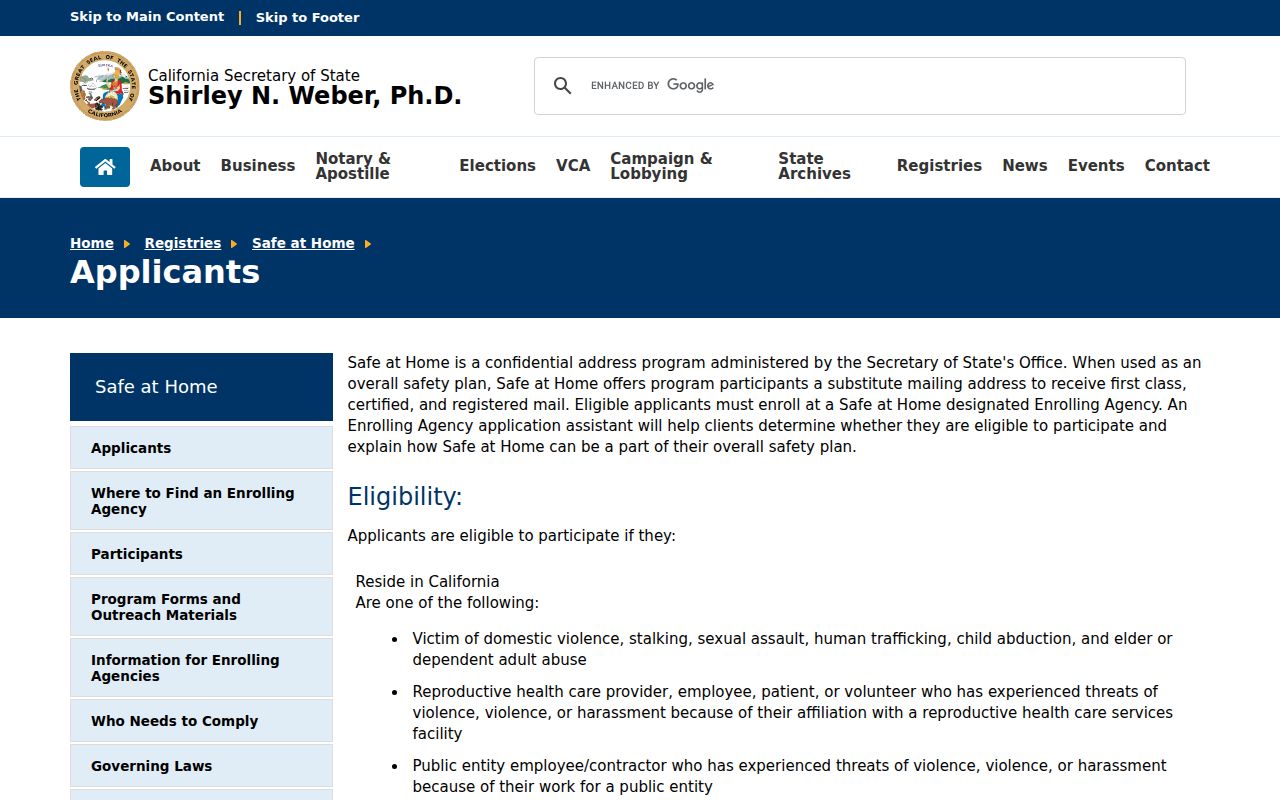
Some Coronado residents are enrolled in the Safe at Home program, which is why a name can be absent from a mailing address in the residents directory.
For deed-fraud monitoring, the ARCC Owner Alert service watches the recorder's index for activity tied to a name or parcel.
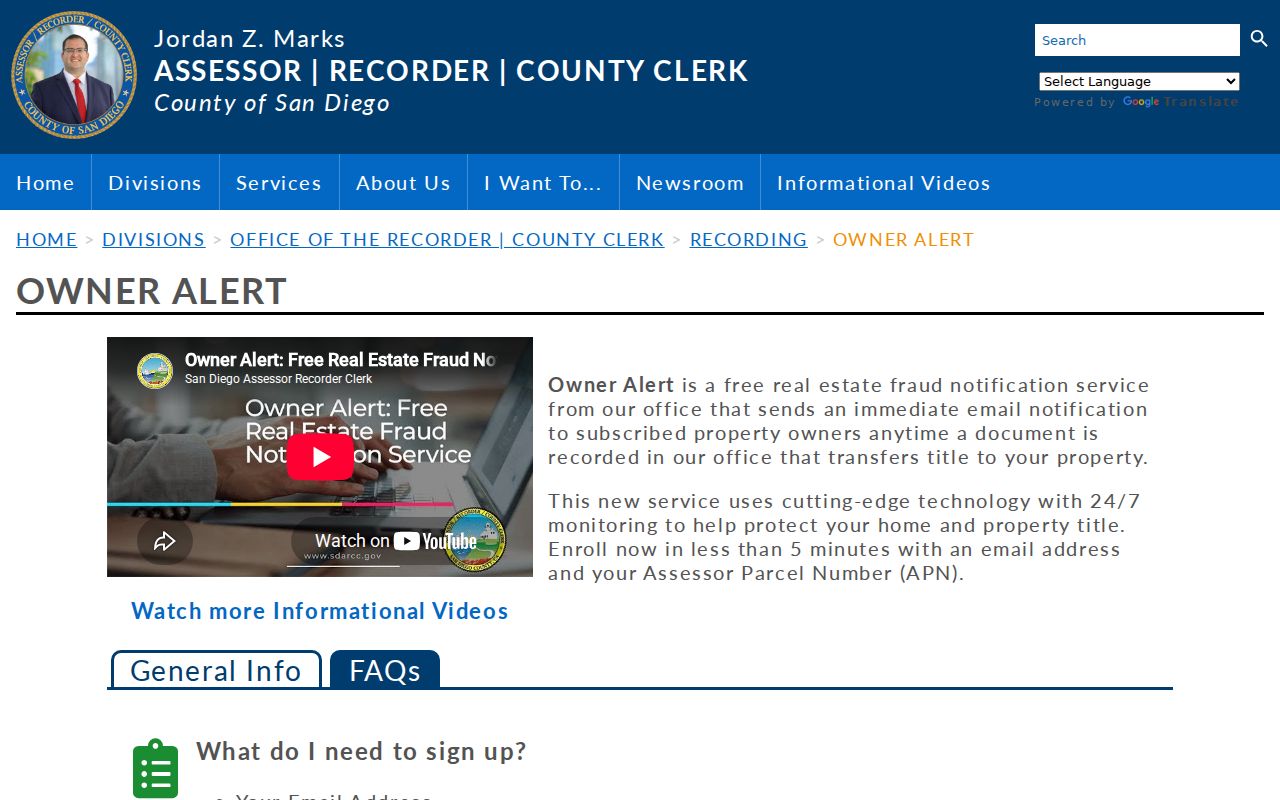
Owner Alert watches the recorder's records for new filings against a name or APN.
Coronado Portal Changes for Resident Records
Access to Coronado records keeps shifting. ARCC dropped APN searching from its website on December 9, 2024. Five office kiosks still offer it, though. Fees climbed on January 1, 2026. San Diego County set birth certificates at $34, death at $26, and marriage at $19. The Superior Court then posted a new fee schedule effective July 1, 2026. So confirm copy and certification charges right before ordering. Any resident lookup plan should account for those moving targets.
Privacy tools are changing too. California's free DROP platform began taking a single encrypted deletion or opt-out request in 2026. It reaches more than 500 registered data brokers. Mandatory processing starts August 1, 2026. DROP can trim commercial compilations. But it cannot touch lawful government sources like a property roll or deed record. The Coronado DROP portal is the official place to start that request.
Coronado's 2025 population estimate sits at 21,094 across 7.81 square miles. That compact footprint makes parcel-by-parcel work in a residents directory quite practical. Still, military turnover, tourism, federal parcels, high-rise ownership, and PO-box mail can complicate things. One name or address can be deceptive. A careful directory search records what each source actually proves, and it leaves unknown facts marked unknown.
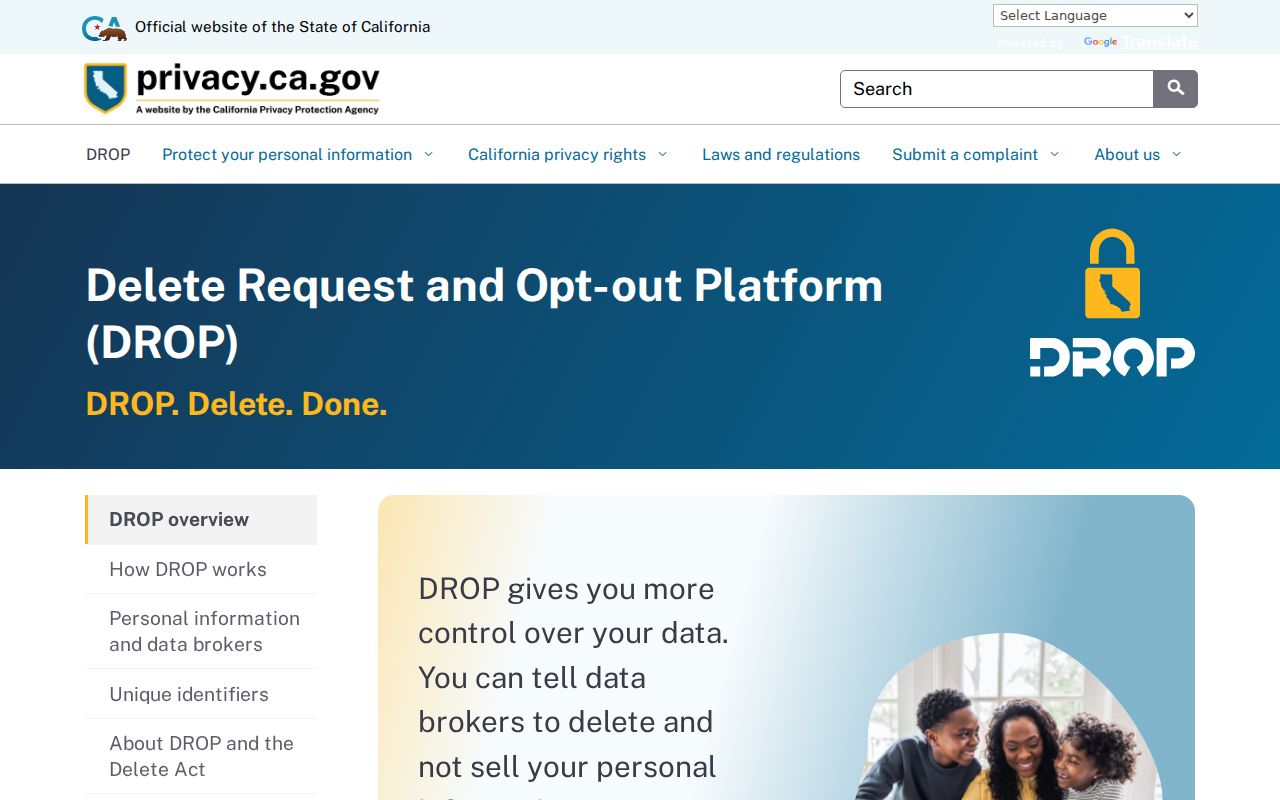
DROP remains the current privacy route for broker-held data. It stands apart from county records held by San Diego County and Coronado.