
Choose a Coronado Resident Lookup Record
The first step in a Coronado resident lookup is to name the fact being tested. Ownership, residence, a filed case, a vital event, a professional credential, and a business affiliation are not interchangeable. The Coronado table below assigns each question to the office or collection that can answer it.
| Record | What it confirms | Where | Access |
|---|---|---|---|
| Coronado parcel and assessor record | Coronado ownership, situs, assessed value, and mailing contact through staff | San Diego ARCC | Web map and roll; owner detail by phone or kiosk |
| Coronado recorded instrument | Coronado named party and property or transaction link | ARCC Official Records | 1970-present index; copies and kiosk APN path |
| Coronado court index and ROA | Coronado party, case number, type, date, and facility | San Diego Superior Court | Index free; file images and copies vary |
| Coronado vital record or index | Coronado birth, death, marriage, or county event clue | ARCC and CDPH Vital Records | Informational and authorized-copy rules differ |
| Business or FBN filing | Coronado entity, agent, officer, DBA, and business address | SOS, ARCC, and Coronado | Search access is public; certification can cost |
| Coronado professional license | Coronado credential, status, city, and public discipline | DCA and individual boards | Free public verification |
| Coronado directory, obituary, or yearbook | Coronado dated household, family, school, or historical clue | Libraries, CHA, and newspapers | Digitized, appointment, or in-library access |
For a Coronado clue, start with the source whose key matches it. An address points to the Assessor and parcel map. A name plus court location points to the Court Index. A family event points to ARCC or CDPH. A historical classmate points to yearbooks and directories. When a current address is the goal, use a property record as an anchor and then corroborate with a second independent source.
Read a Coronado Resident Lookup Court Match
The San Diego Superior Court’s Court Index for Coronado searches civil, criminal, family, mental-health, and probate filings. It offers three useful modes: Party Name, Case Number, and DA Number. Party Name can be narrowed by case type and location. Case Number uses a case-type and case-location choice; long-form numbers may be entered as the year plus eight digits without dashes. DA Number is for criminal District Attorney case numbers.
| Result field | Meaning | Verification step |
|---|---|---|
| Coronado case title | Coronado caption of the filed matter | Compare parties and location. |
| Coronado case number | Coronado unique court identifier | Use it to request the official file. |
| Coronado facility and type | Coronado location and category | Separate local, family, probate, and criminal matters. |
| Coronado filing date | When the Coronado matter entered the court | Match the person’s known time and place. |
| Coronado parties | Coronado names and party roles | Do not treat a name match as a finding. |
The Coronado court index does not show charges or disposition and is not the official court record. Dismissed cases can remain indexed. Cases before 1974, juvenile matters, and some traffic or minor-offense records are excluded. Civil, small-claims, and probate Registers of Actions provide filing and proceeding summaries. Some images for cases begun after January 1, 2008 can be purchased online; courthouse kiosk viewing is free and prints are $0.50 per page.
A Coronado federal case belongs in PACER for the Southern District of California. Do not ask ARCC or the city clerk for a court file they do not hold.
The Coronado public search modes are visible at the Superior Court Court Index.
Defeat the Coronado Resident Lookup Name Trap
A Coronado name alone is a weak identifier. Normalize the surname, middle initial, suffix, former name, married name, and spelling variants. Add the full Coronado case location, approximate date, spouse, occupation, license city, business name, or property legal description. A court hit without a date and party role may be unrelated. A directory line with the same surname may describe a different household. A business agent’s address may be a service address rather than a residence.
Use two independent facts before treating a Coronado result as a likely match. For example, connect a recorded party to the same parcel legal description and a directory entry from the same year. Or connect a business filing to a license record and a court location. Keep the source, date, party role, and confidence beside the name.
- Index
- A finding aid with searchable fields, not necessarily the underlying record.
- Official image
- The filed or recorded document that can contain details omitted from an index.
- Party role
- The person’s relationship to a case or instrument, such as grantee, petitioner, or respondent.
- Certified copy
- A custodian-issued copy attested as a true copy for an authorized purpose.
Coronado commercial compilation services can combine public filings with stale or mismatched data. They may help produce a lead, but the custodian record controls the verification.
Check Coronado Resident Ownership Without Claiming Residence
The San Diego Assessor’s web roll for Coronado searches APN, address, or street name and shows assessed values and exemptions. California rules prevent online owner-name display and search. Assessor Public Information at 619-236-3771 and county kiosks provide ownership and address information. ParcelQuest or the parcel map supplies geometry, APNs, and characteristics.
For Coronado ownership, keep situs and mailing address separate. A matched pair can support a Coronado owner-occupancy clue, but it does not prove that the owner is home or that other household members are absent. Trusts, second homes, administrative addresses, and off-island mail are all possible. Non-owner occupants and household members are not assessor fields.
If the lookup shifts from one person to everyone along a street, use the address workflow on the Coronado street directory page rather than rebuilding a parcel chain inside a name search.
Find a Coronado Resident’s Business Affiliation
A Coronado business search through California Secretary of State bizfile Online uses entity name or file number. Advanced filters include Coronado entity type or group, status, initial-filing date range, and publicly traded disclosure. Results can show entity number, registration date, status, jurisdiction, principal and mailing addresses, agent, officers or managers on Statements of Information, filing history, and PDFs. Search and many filings are free; ordered certification requires an account and payment.
County fictitious business name filings, a Coronado Business Certificate, and state professional-license records add separate affiliation clues. The city certificate costs $25 plus the $4 state accessibility fee, expires December 31, and is reviewed for zoning, building, and fire compliance. A citywide certificate list is not advertised as a searchable register, so request a focused list under CPRA when an identifiable record is needed.
For a Coronado license, DCA’s advanced search can filter board, credential, city, county, status, and discipline. ABC location reports can show license type, status, primary owner, DBA, premises and mailing address, expiration, action, and conditions. A Coronado restaurant, hotel, or professional address is a public business connection, not proof of a home.
Use the California bizfile search for a Coronado entity.
The Coronado business search illustrates how a name can be tied to a public entity role without turning a business address into a resident claim.
Use Coronado Resident Lookup Vital Copies
For a Coronado event, San Diego County ARCC handles county birth, death, and marriage certificates, with CDPH Vital Records as a statewide fallback. Health and Safety Code §103526 distinguishes authorized certified copies from informational copies. Authorized copies are limited to listed relationships, representatives, certain agencies, or court-order paths. Others may generally obtain informational Coronado birth, death, or nonconfidential-marriage copies when eligible. Confidential marriage access is narrower, generally the registrant or a court order.
| Event | 2026 county fee | Request path |
|---|---|---|
| Coronado birth | $34 | Counter, mail, or online; county records for Coronado are usually available about three weeks after the event. |
| Coronado death | $26 | Coronado ARCC or CDPH, with eligibility rules. |
| Coronado nonconfidential marriage | $19 | Coronado authorized or informational copy based on the requester. |
| Coronado confidential marriage | $19 | Coronado registrant or court order; existence-letter route may apply. |
For Coronado copies, in-person orders require valid ID and accept cash, check, money order, or card, with a $2.50 card charge. Mail orders for authorized copies use a notarized sworn statement. VitalChek adds $12.95 handling and optional $19 expedited service. Fees are retained when no matching record is found and a Letter of No Record is issued. Historical Coronado indexes, church registers, newspapers, and library databases can supply a lead without conferring eligibility for a certified copy.
Verify a Coronado Resident Across Records
A useful Coronado resident lookup ends with a short, repeatable verification chain. It begins with a Coronado address or name clue and ends with the custodian source that best fits the claim. The chain below is designed for a present address clue, but the same logic works for genealogy or an estate search.
- Normalize the person’s name and write down the known address, date, spouse, occupation, or business link.
- Use the assessment roll or ParcelQuest to obtain the APN, then ask Assessor staff or a kiosk for owner and mailing context.
- Search the owner or person in Official Records, using the instrument date and legal description to test the match.
- Run the Court Index with party name, case type, location, and date; record the case number and party role.
- Close with a vital, business, license, directory, obituary, or official file that independently supports the identity.
For Coronado, do not use the voter self-lookup as a stranger-name search. It verifies the requester’s own registration using address and birth date. When a Coronado record is wrong, contact the office that created it. A directory cannot rewrite an assessor, recorder, court, or vital index.
Use a Coronado Resident Lookup for Heirs
An heir may appear as a petitioner, personal representative, or interested person in a probate Register of Actions and in an obituary. The San Diego Superior Court Civil, Small Claims, and Probate ROA provides summaries; the file or kiosk supplies the next detail. A former classmate may be found in Coronado High School yearbooks, directories, newspapers, or CHA photographs. A birth-parent or adoptee question must use California’s official confidential adoption-information and consent channels rather than an open birth file.
For custody information, the San Diego County Sheriff’s “Who’s in Jail” search accepts first and last names, with the first two letters useful when spelling conflicts occur. It uses a case-insensitive CAPTCHA and may show booking, case, facility, and pending-appearance fields. CDCR covers state prisoners. The California Megan’s Law registry has its own public-safety rules and misuse warning. None of these is a general Coronado resident list.
The Coronado sheriff search can be opened at Who’s in Jail.
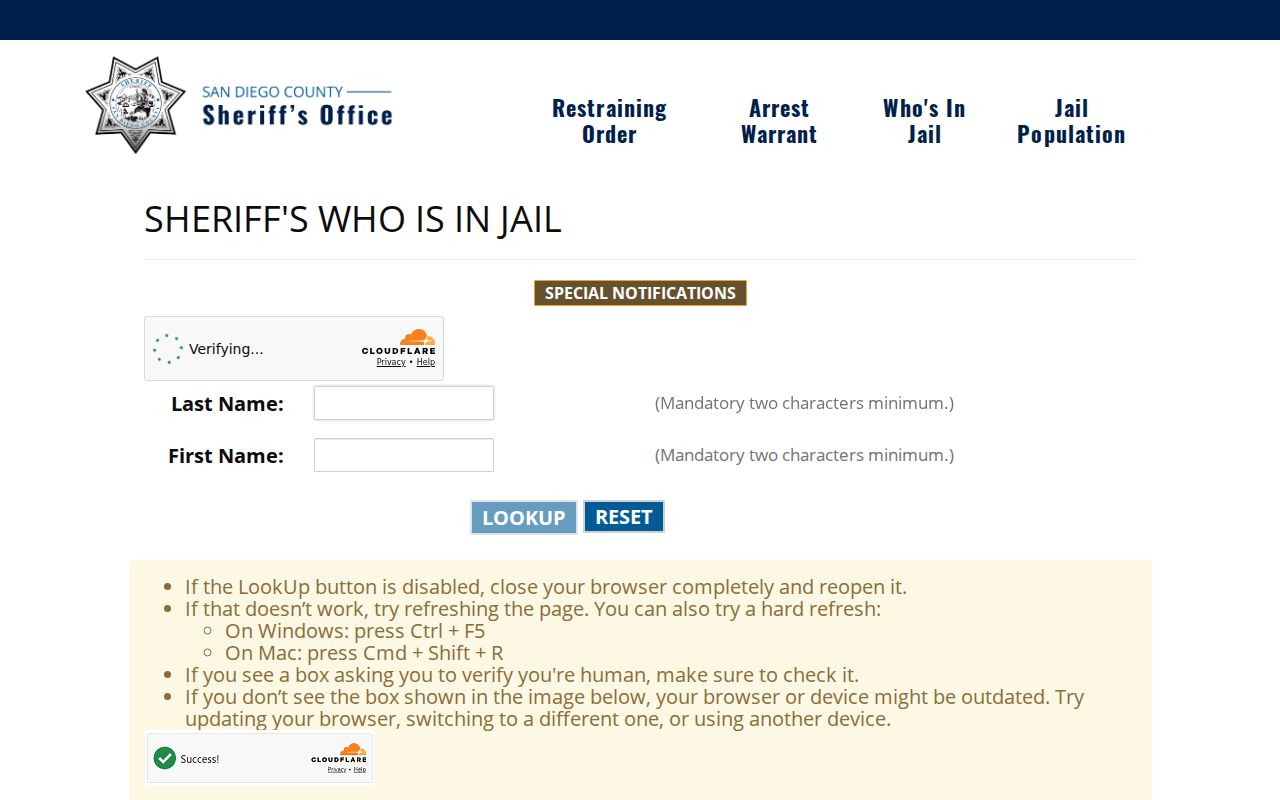
The Coronado custody search is a narrow official lookup with its own fields and limits, not a substitute for property, court, or family records.
Where a Coronado Resident Lookup Ends
Coronado privacy rules close important paths. Government Code §7924.000 and Elections Code §2194 restrict Coronado voter fields and block a general public “voters on this block” search. Safe at Home can substitute a mailing address and support confidential registration for eligible participants. Motor-vehicle data is protected by the federal DPPA. Juvenile, sealed, adoption, confidential-marriage, and specified family records remain limited. A focused CPRA request can seek an identifiable nonexempt city record, but it cannot turn protected data or a private association roster into a resident list.
Coronado research also meets the California Consumer Privacy Act, which gives rights to know, delete, correct, opt out of sale or sharing, and limit sensitive information. Legally public government information such as real-property and professional-license records is excluded from CCPA personal information. The 2026 DROP platform can send one encrypted deletion or opt-out request to more than 500 registered brokers, but deleting a broker copy does not erase the county source.
Lawful use. A Coronado resident lookup is for personal, lawful research, family history, reconnecting, and civic understanding. California Penal Code §646.9 and Code of Civil Procedure §527.6 address stalking and civil harassment. Never use a name or address to stalk, intimidate, or harm anyone.
For a Coronado result, verify it with the custodian. A name in a Coronado index is a lead until the date, location, role, and source record line up.